Few signs are as universally recognised as "No Parking" - yet there's a real difference between the official, legally defined version used on public roads and the versions most commonly sold and installed on private property. A no parking sign board can mean either, depending on where it's going, and understanding that difference helps you order the right thing. This guide covers the official specification, the practical commercial format you'll actually find from most signage vendors, and where each is appropriate.
The Official No Parking Sign Under IRC 67
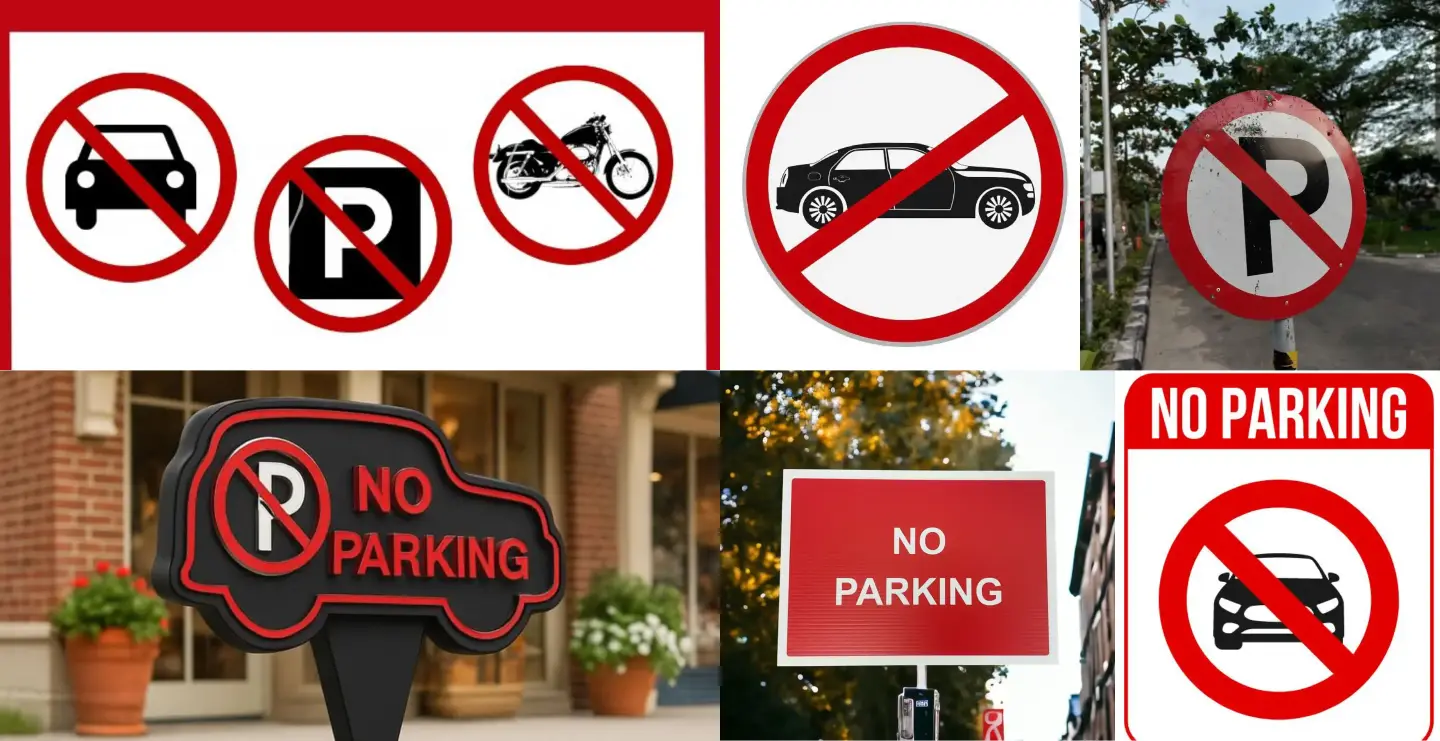
As a regulatory traffic sign under India's IRC:67-2012 road sign code, the standard "No Parking" design follows the same circular, prohibition-style logic used across most of the Vienna Convention countries: a blue circular background, with a red ring or border around the edge, and a red diagonal bar running across it. This visual language - blue field, red ring, red diagonal slash - is what makes the sign instantly recognisable as a parking prohibition even to someone who can't read the accompanying text, and it's consistent with how other prohibition signs (No Entry, No U-Turn, and similar) are constructed under the same code.
How Commercial No Parking Boards Are Usually Made
In practice, most "No Parking" boards sold by signage vendors in India aren't cut into a true circular shape - they're square or rectangular PVC or aluminium boards with the circular prohibition symbol printed within them. This is simply more practical and cost-effective to fabricate than custom-cutting every sign into a circle, and the printed symbol remains just as recognisable. Common commercial formats include compact 300x300mm boards for smaller spaces and larger 600x600mm pole-mounted boards for wider visibility, often finished with a high-intensity prismatic reflective grade so the sign stays visible after dark.
Where No Parking Signs Are Used


- Public roads and streets – Installed by traffic police or the municipal road authority as legally enforceable signage.
- Residential societies and gated communities – Used to manage visitor parking and keep driveways or fire lanes clear.
- Hospitals and clinics – Often placed near emergency entrances and ambulance bays where blocked access is a genuine safety risk.
- Commercial buildings and offices – Used to reserve space for deliveries, designated parking, or building access.
- Factories and industrial premises – Placed near gates, loading areas, and fire exits where clear access needs to be maintained at all times.
Who Can Install an Official No Parking Sign?
On a public road, a legally enforceable No Parking sign is installed by the traffic police or local municipal authority - not by a private individual or business, even if the area is immediately outside their property. A signage company fabricating such a sign for a public road is typically working to a government tender or work order, similar to other official road signage. On private property - a society's internal roads, a factory campus, a hospital's own driveway - the property owner can install a No Parking sign freely, since it functions as the owner's own advisory rule for their premises rather than a public traffic control device, even though it commonly borrows the same recognisable red-and-blue design for clarity.
Materials and Durability
- PVC foam board – Lightweight and economical, suited to indoor or semi-covered locations.
- Aluminium – More durable and weather-resistant, the standard choice for outdoor, long-term installations.
- ACP sheet – A rigid, weatherproof option often used for larger pole-mounted boards.
- Retroreflective sheeting – Applied over the board to keep the sign visible under headlights or low light, especially important for driveways and parking areas used after dark.
Design Variations for Private Properties
While the core red-and-blue prohibition symbol is best kept consistent for instant recognition, private property signs often add supplementary text beneath it - the society or building's name, a note like "Visitors Only in Designated Areas," or a warning about towing. Bilingual text, combining English with the local regional language, is common for broader readability. Because these are advisory rather than statutory signs, property owners have more flexibility in wording than would be appropriate for an official public road sign, though keeping the core symbol recognisable is still worth preserving for clarity.
Standard Sizes for No Parking Boards
For smaller, close-range installations - a narrow gate or a single parking bay - a compact size around 300x300mm is common and sufficient. For driveways, wider roads within a complex, or anywhere the sign needs to be seen from a greater distance or by moving vehicles, a larger board, often 450x450mm to 600x600mm, pole-mounted at a visible height, is more effective.
How to Order a No Parking Sign Board
- Decide whether the sign is for a public road (requiring coordination with the relevant authority) or private property (where you have full design flexibility)
- Choose a size appropriate to the viewing distance - larger for driveways and roads, smaller for tight spaces
- Confirm reflective sheeting if the area is used or driven through after dark
- Decide on any supplementary text, keeping the core red-and-blue symbol clearly recognisable
Ask Instant Pricing from Expert Signage Manufacturers
Contact Now →Frequently Asked Questions
What colours does an official No Parking sign use in India?
The standard design under IRC:67-2012 uses a blue circular background with a red ring and a red diagonal bar across it, following the same prohibition-sign logic used across much of the Vienna Convention.
Why are most No Parking boards square or rectangular instead of circular?
It's more practical and cost-effective to print the circular prohibition symbol onto a square or rectangular board than to custom-cut every sign into a true circle, and the symbol remains just as recognisable either way.
Can I install a No Parking sign outside my house on a public street?
A legally enforceable sign on a public road needs to be installed by the traffic police or municipal authority; a sign you put up yourself on a public street functions more as a request than an enforceable rule.
Do housing societies need permission to install No Parking signs?
Within their own private premises - internal roads, gates, driveways - societies can generally install these freely as their own advisory rule, without needing traffic authority approval.
What size No Parking sign is best for a narrow gate?
A compact 300x300mm board is usually sufficient for close-range spots like a single gate or parking bay, where the sign will be seen from a short distance.
Is reflective sheeting necessary for a private driveway sign?
If the driveway or area is used after dark, reflective sheeting significantly improves visibility and is worth the small extra cost over a non-reflective board.
Can I add my building or society's name to a No Parking sign?
Yes, on private property signs this is common and adds helpful context, as long as the core prohibition symbol remains clear and recognisable.
Conclusion
A no parking sign board looks simple, but getting the details right - the correct symbol convention, an appropriate size for the viewing distance, and the right installation route depending on whether it's public or private property - makes the difference between a sign people actually notice and one that gets ignored. For public roads, work through the relevant authority; for your own premises, the same recognisable design gives you a clear, flexible way to manage parking on your terms.