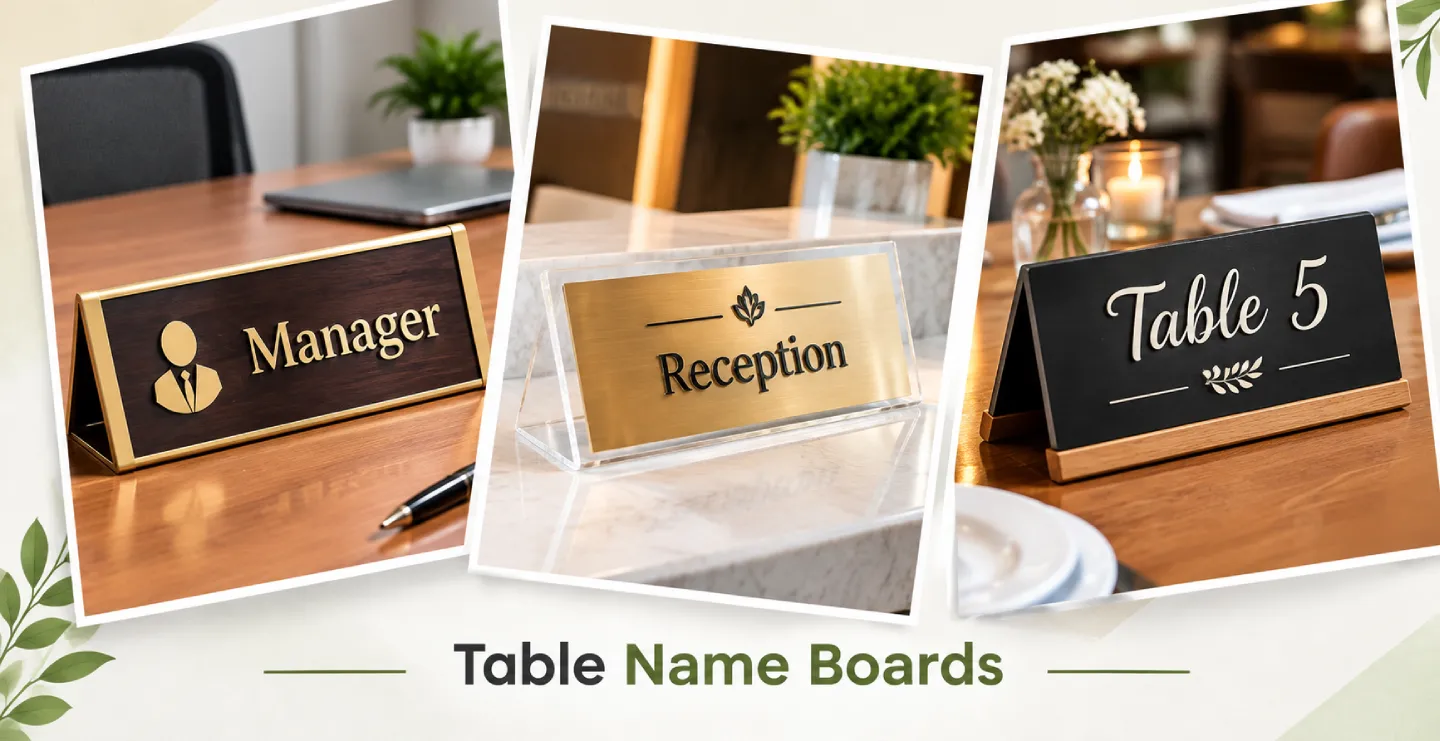
Not every name board hangs on a wall or a door - a huge number of them sit flat on a surface, facing whoever is seated across from them. A table name board covers everything from a manager's desk plate to a wedding place card to a bank counter sign, and the right format depends entirely on where it will sit and who needs to read it. This guide walks through the common formats, materials, and use cases for table-mounted name boards, along with practical tips for ordering ones that actually get read.
What is a Table Name Board?
A table name board is any name plate designed to stand or sit on a flat surface rather than being fixed to a wall or door. Unlike wall-mounted signage, it needs to be legible from a seated position a few feet away, and it's often designed to be moved, replaced, or repositioned far more easily than permanent wall signage. This makes it a distinct category with its own design rules, even though the materials overlap with other types of name plates.
Common Formats for Table Name Boards


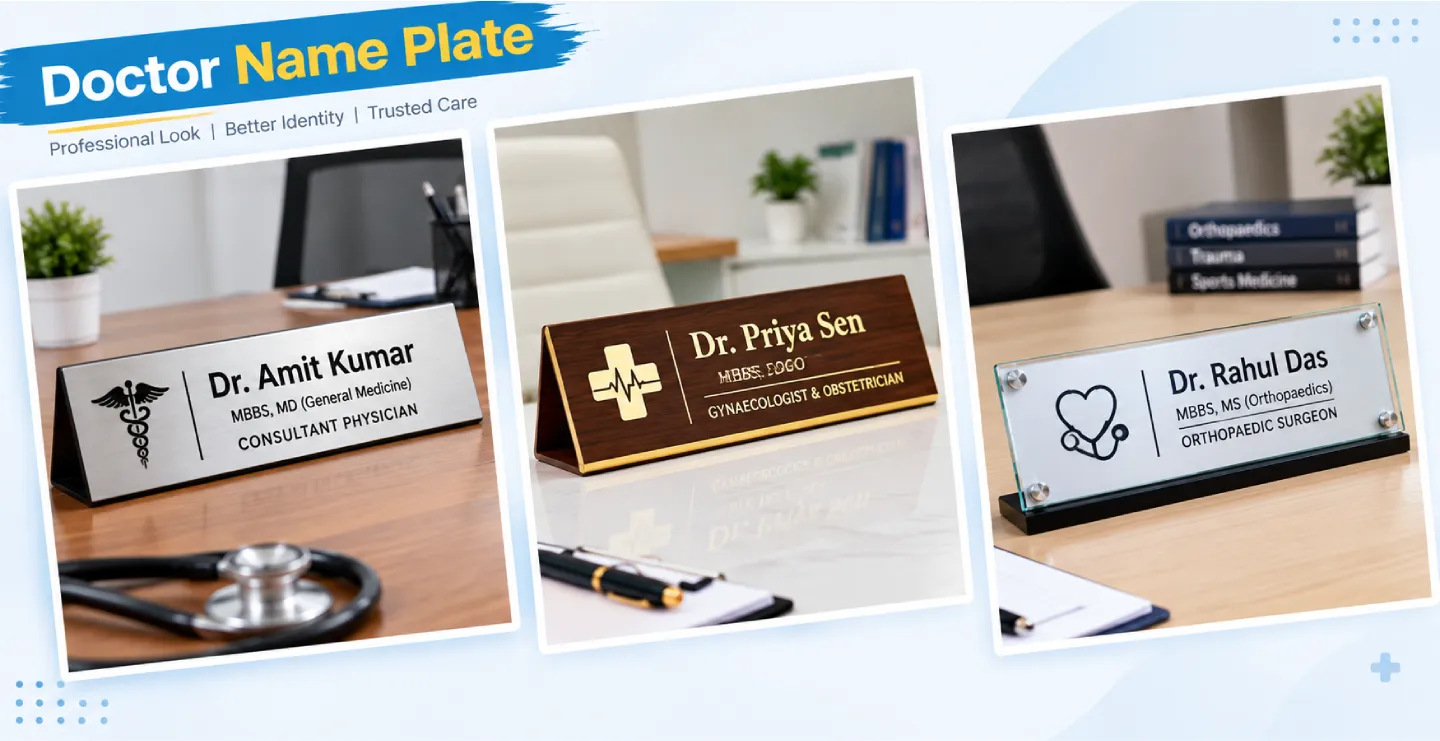
- Flat desk plates – A simple rectangular plate that sits flat or on a small stand, most common for office desks and reception counters.
- Tent or pyramid cards – A folded, triangular format that displays text on both sides, ideal for meeting tables, exam halls, or any setting where people approach from more than one direction.
- L-shaped or angled plates – Bent at roughly 90 degrees so the text tilts up toward a seated visitor rather than lying completely flat.
- Slide-in card holders – A reusable frame or holder with a paper or laminated card inside, popular anywhere names change frequently.
- Freestanding block or stand plates – A solid base with the name plate mounted upright, giving a more permanent, weighted feel than a folded card.
Where Table Name Boards Are Used
This is one of the widest-ranging categories of signage because almost every seated, face-to-face interaction benefits from one:
- Office desks and workstations, showing an employee's name and designation
- Reception and front-desk counters, labelling the desk or the person staffing it
- Conference rooms and meeting tables, especially for visiting guests or panel discussions
- Hotel front desks and concierge counters
- Restaurant and banquet tables, for table numbers or reserved seating names
- Wedding and event seating, as personalised place cards
- Bank counters and government service windows, identifying the staff member or counter number
- Exam halls, showing invigilator names or seat allocations
Materials Commonly Used
Because table name boards are handled more often than wall-mounted ones, material choice leans toward things that are lightweight and won't chip or scratch easily.
- Acrylic – The most popular choice, lightweight, easy to clean, and available in many colours and finishes.
- Wood – Adds warmth and a premium feel, often used for boardroom or leadership desk plates.
- Metal (brass or steel) – A formal, long-lasting option for permanent desk plates that won't be swapped often.
- PVC or laminated card – Budget-friendly and practical for temporary or frequently changed names, such as event seating.
- Glass – Occasionally used for a premium, minimal look on executive desks.
Design Considerations for Readability
A table name board is read from much closer range than a wall sign, but often at an angle, so a few design choices matter more here than elsewhere. Tent-style cards should have text sized so it's legible from across a table, not just close up. L-shaped or angled plates work better than flat ones for a seated visitor looking down slightly, since the tilt brings the text closer to their natural eye line. If the board will be seen from both sides of a table, a double-sided tent or a two-sided flat plate is worth the small extra cost over a single-sided design.
Fixed vs Interchangeable Table Name Boards
For a permanent desk assignment, a fixed engraved or printed plate makes sense and looks more polished. For anything that changes regularly - visiting speakers, rotating meeting attendees, temporary desk assignments, or event seating - a slide-in holder with a replaceable card saves the cost and delay of reordering a new solid plate every time. Many offices use a mix: fixed plates for permanent staff desks and interchangeable holders for shared or hot-desking spaces.
Sizing Guidelines
Standard office desk plates are typically around 8x2.5 inches to 10x3 inches. Tent cards for meeting tables usually run smaller, around 4x6 inches per folded side, so they don't dominate the table surface. Reception counter plates can be a little larger, closer to 10x4 inches, since they may need to be read from a short distance rather than right up close. Event place cards are usually the smallest, often just large enough to fit a name and table number clearly.
Customisation Options
Beyond the name itself, many table name boards can include a designation or title, a company or event logo, a QR code linking to a profile or menu, colour coding to indicate department or table grouping, and matching branded fonts and colours for a consistent look across a full set of desks or an event's seating.
Ordering Table Name Boards in Bulk
For offices or events needing many plates at once, it helps to finalise one template and get a single sample approved before the full batch goes into production. Standardising the size, font, and material across every plate keeps the overall look consistent, and it's worth keeping a few blank or reusable holders on hand for last-minute changes rather than reordering a whole new fixed plate.
Frequently Asked Questions
What's the difference between a tent card and a flat desk plate?
A tent card is folded into a triangular shape and shows text on both sides, making it readable from multiple directions, while a flat desk plate typically faces only one direction.
What size is standard for an office desk name plate?
Most office desk plates fall between 8x2.5 inches and 10x3 inches, though the ideal size also depends on the desk's available space and how much text needs to fit.
Which material is best for a table name board that gets handled often?
Acrylic is generally the most practical choice for frequent handling, since it's lightweight, easy to wipe clean, and resistant to everyday scuffs.
Can table name boards be reused for different events?
Yes, slide-in card holders are designed exactly for this - the outer frame stays the same and only the printed card inside needs to be replaced.
Are angled or L-shaped plates better than flat ones?
For a seated visitor looking slightly downward, an angled plate is usually easier to read than one lying completely flat, since it tilts the text toward their eye line.
Can a QR code be added to a table name board?
Yes, many businesses now add a small QR code linking to a digital profile, menu, or contact card, particularly on reception and event table plates.
How far in advance should bulk table name boards be ordered?
For a large batch, such as for a new office or a big event, ordering at least two to three weeks ahead allows time for a sample approval before full production.
Conclusion
A table name board might be small, but choosing the right format - flat, tent, or angled - and the right material for how often it will be handled makes a real difference to how well it actually works. Matching the format to the setting, whether that's a permanent office desk or a one-time event table, is the simplest way to get signage that looks good and does its job.